[2026082101-trains]
When I was eight years old or so, in the mid-1960s, my grandfather bought my brother and me a West-German-made, H0-scale Märklin model train set for Christmas. Here is the first of many logos in this post:
As a result of this, I grew up with more hands-on knowledge of the German rail system than the American one, though I didn't make it to Germany for another 20 years. On my first trip to Europe, I used a Eurail Pass to travel all over West Germany, Austria, Czechoslovakia, and Switzerland. A few years after that, I lived in East Germany for eight months and became very well acquainted with its rail system, the Deutsche Reichsbahn, which weirdly preserved the name of the pre-1945 German rail system.
West Germany's system was the Deutsche Bundesbahn (German Federal Railway), or DB.
After reunification, the Bundesbahn rebranded to Deutsche Bahn (German Railway), still conveniently DB, and absorbed the Reichsbahn in 1994.
I was along for this ride.
A distinctive feature of East German train travel was Mitropa, the state company that operated dining cars and train-station cafes.
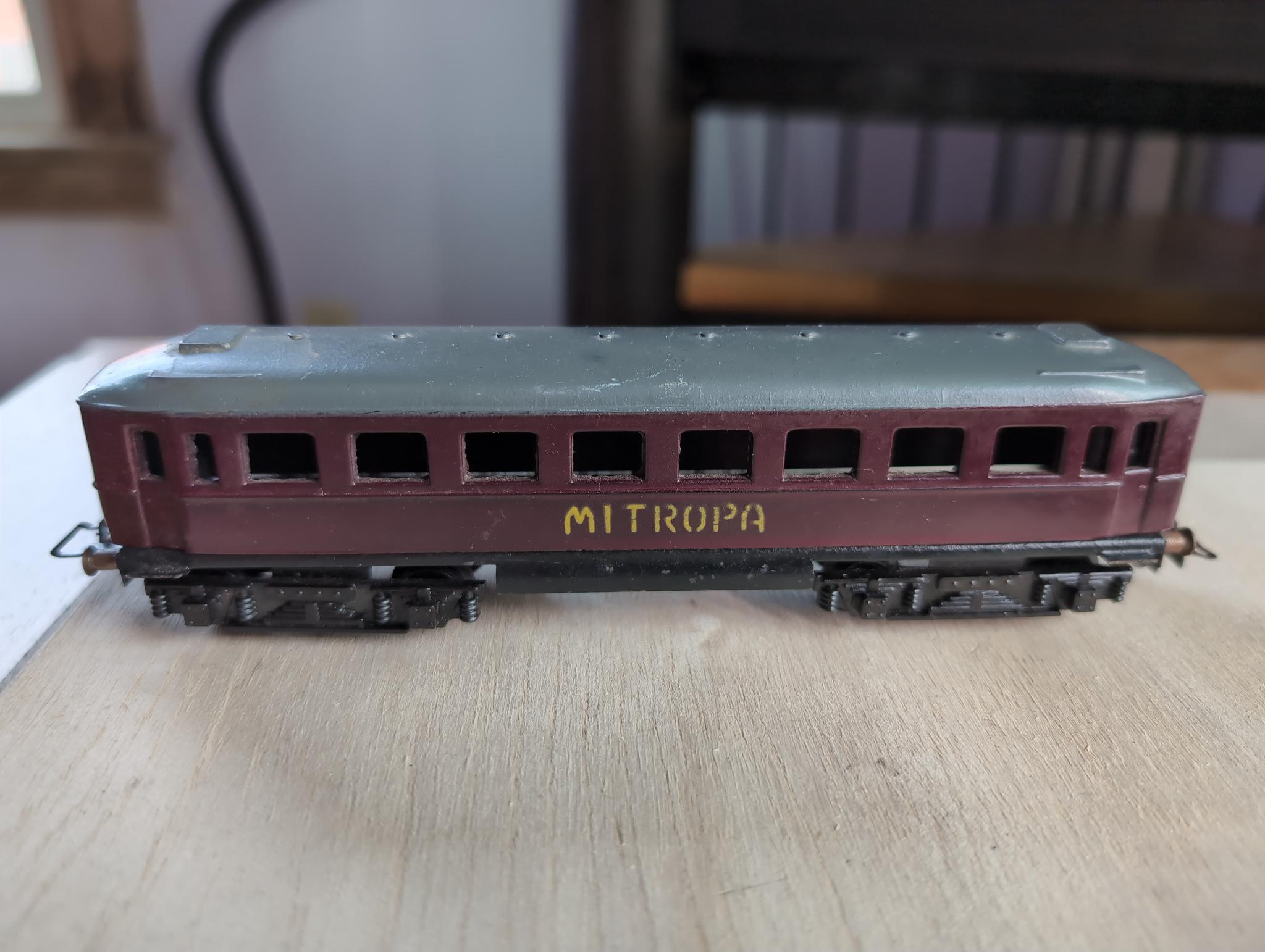
Mitropa food was awful, at least in the cafes. Late at night, a Mitropa cafe might be the only thing open in East Berlin, serving leathery bread rolls, dubious cold cuts, and poisonous coffee. Over the following decades my Mitropa memories evolved from outright trauma into perverse fondness. When I ran across a Mitropa serving-platter in an antique store, I was thrilled for no good reason. In the same vein, I recently acquired an H0-scale model of a Mitropa dining car at a Berlin flea market.
Back in Seattle, I dug out the plastic carton containing that old Märklin set. It had been stored undisturbed for decades. I put together some track and tried out the locomotive, which sort of worked, minus features such as headlights and a reverse function. One thing led to another and I ended up taking it apart for cleaning and repair with help from online videos. I also made a plywood base for a modest but permanent track setup, now occupying my underused dining table.
The Mitropa dining car travels its constrained route hitched implausibly to several heterogeneous West German freight cars and pulled by a 1930s steam locomotive. The unfolding plan is to find some more East German rolling stock when I am back in Berlin. East Germany produced model trains, too, and there is lots of used inventory floating around (such as my dining car).
I'm not too interested in the historical deep-dives that obsess a lot of model train enthusiasts, but I have my own personal history in several Germanies, and it might be fun to build a simulacrum of that. The resulting world, confined to a smallish table-top layout, and located in Seattle, would combine:
-
West German track acquired long before I went to any Germany
-
East German rolling stock acquired long after East Germany disappeared
-
An urban landscape of mixed Plattenbauten (such as the ones near me in Berlin) and Altbauten (such as the one I live in). I only just discovered that such things are available for modellers, made to H0 scale.
-
A Fernsehturm, since the original is visible from my Berlin balcony. Alas, it cannot be to scale -- the Berlin Fernsehturm at H0 scale (1:87) would be 14 feet high. Mine will be more a maypole than a TV tower. I do happen to have one, however, ready to be deployed.
This project has required learning some new vocabulary so that I know what the German-language forums and the vending sites are talking about. I knew the practical train things, of course: der Gleis, der Bahnsteig, der Schaffner, der Wagen, u.s.w. I even knew that a Rangierer was a switchman/shunter from reading Uwe Johnson. I had to learn these:
-
die Schranke – barrier
-
die Weiche – switch
-
die Bahnschwelle – railroad tie
-
das Gleisbett – The trackbed, consisting of crushed-rock ballast in real life and a bent-metal base in the Märklin M-Gleis system that I have.
-
der Kontakgleis – In Märklin, a piece of track with an electrically isolated segment of rail that triggers a component when shorted by a passing train car wheel.
-
der Schaltgleis – In Märklin, a piece of track with a mechanical switch that flips forward or back when a train passes, sending a signal to another component.
-
der Haftreifen – An O-ring that provides friction on the drive wheet of a Märklin locomotive.